

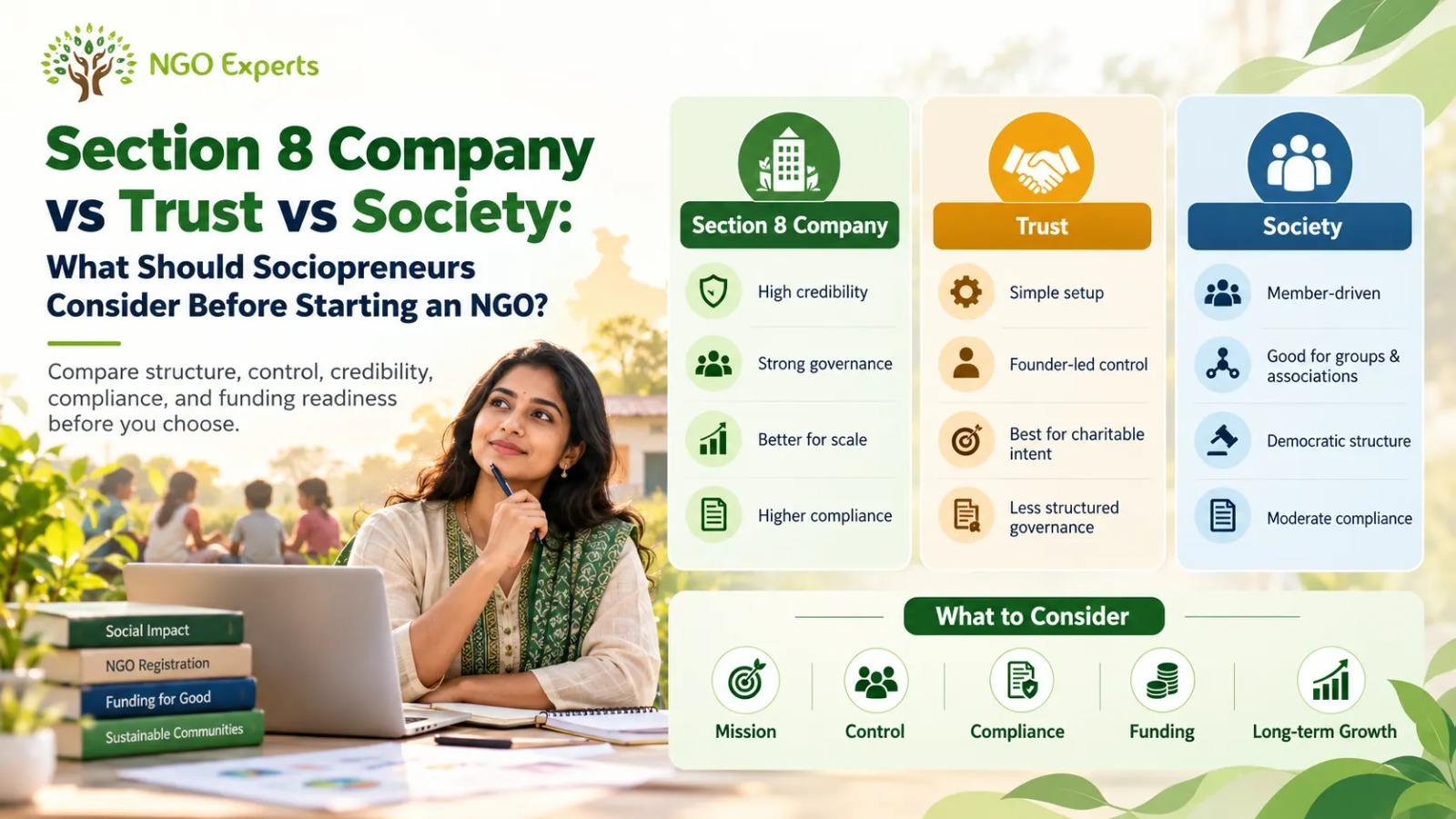
Section 8: Company vs Trust vs Society: What Should Sociopreneurs Consider Before Starting an NGO?

You have an idea that could change a village, a school, or a supply chain. A Section 8 company, a trust, and a society answer that question in three different ways. This guide helps sociopreneurs compare a Section 8 company vs trust vs society on control, income, risk, and funding, using 2026 rules.
Choose a Section 8 company if you want to earn revenue, add co-founders, and show public accounts. Choose a trust if you want fast, low-cost, founder-led control. Choose a society if you want a member-run group. All three can earn income, but none can pay profit to owners.
Section 8 Company vs Trust vs Society
The Section 8 company vs trust vs society choice has six legal differences.
| Section 8 company | Trust | Society | |
| Separate legal entity | Yes | Yes | Yes |
| Liability | Limited | As per the deed | Limited |
| Founder control | Moderate | High | Moderate |
| Public accounts | Full MCA public database | No | Partial |
| Minimum people | 2 directors | 2 trustees | 7 members |
| Regulator | Registrar of Companies | State Sub-Registrar | State Registrar: |
What Should You Know Before Starting an NGO?
Before starting an NGO, consider these six key points for NGO registration to choose the right registration type and avoid legal or compliance issues in the future.
- Control and exit. A trust gives you the tightest hold. A Section 8 company lets you add directors under the articles. A society needs elected members so that control can shift.
- Revenue plan. All three can earn from donations, grants, service charges, and sales. The surplus must go back to your objects.
- Personal risk. A trust leaves trustees exposed unless the deed limits it. A company or society does not.
- Credibility with funders. Public MCA filings let a donor check your accounts.
- Compliance bandwidth. A small team can struggle with a company’s yearly filings.
- State rules. Trust and society law varies by state, so ask your local Registrar first.
Can You Earn Income Through an NGO?
Yes, an NGO can earn income, but it cannot distribute profits as dividends to its founders or members.
A Section 8 Company can earn a surplus through activities related to its objectives, such as training, repair services, or selling affordable products. However, the income must be used for the organisation’s objectives.
If you want to earn personal profits or provide returns to investors, a for-profit business may be more suitable.
Some founders operate both an NGO and a separate business. This requires proper legal, tax, and financial planning, so consult a chartered accountant before proceeding.
Funding Access: CSR, Government and Foreign Money
Your NGO’s access to funding depends more on its registrations than on its legal form.
- CSR: A Section 8 company, registered trust, or society needs 12A, 80G, and Form CSR-1, plus three years of track record unless a company set it up.
- Government grants: A Darpan ID is mandatory for Union grants, FCRA registration, and certain tax exemptions.
- Foreign money: The FCRA Rules, 2026 are in force, and the Amendment Bill is still pending. A parliamentary committee heard stakeholders on 12 October 2026. Plan for stricter reporting.
- Tax: 12A and 80G are now Sections 332 and 354 of the Income-tax Act, 2025.
Cost of Starting an NGO: Section 8 Company vs Trust vs Society
A trust costs the least in year one, and a Section 8 company costs the most.
| Estimate | Trust | Society | Section 8 company |
| Setup plus first-year compliance | ₹10,000–₹20,000 | ₹20,000–₹40,000 | ₹8,000–₹15,000 |
New Section 8 companies get the license with incorporation through SPICe+, and the core government fee is waived up to ₹15 authorized capital.
Section 8 Company vs Trust vs Society: Myths vs Facts
Six myths about Section 8 company vs trust vs society mislead first-time founders, so check each one.
| Myth | Fact |
| “A Section 8 company can pay me a profit share.” | It cannot distribute dividends. |
| “A trust is always safest.” | Trustee liability is unlimited unless the deed limits it. |
| “Only a company can take CSR money.” | Trusts and societies qualify with 12A, 80G and CSR-1. |
| “Societies are easy to start.” | They need seven members and take 15–30 working days. |
| “Registration gives me tax exemption.” | You still need Section 332 and Section 354 approvals. |
| “One law covers all three.” | They sit under different laws and regulators. |
Which NGO Structure Is Right for You? A 5-Question Checklist
Answer these five questions to help choose the right legal structure for your NGO.
- Do you plan to work with co-founders or run a structured organisation? Consider a Section 8 Company.
- Are you starting a small, founder-led charitable project? Consider a Trust.
- Do you want members to elect leaders and make decisions together? Consider a Society.
- Do you plan to receive CSR funding, government grants, or foreign contributions? Check the eligibility and compliance requirements before choosing a structure.
- Can you manage the ongoing compliance costs and paperwork? Compare the annual costs of all three structures before registering.
Tip: Choose the structure that matches your NGO’s goals, management style, funding plans, and budget.